
Planetary gearboxes: maximum torque, minimal footprint.
When high torque meets tight installation space, there is hardly a way around the planetary gearbox: load sharing across multiple planet gears delivers high power density in a compact, coaxial configuration — from 5 to 2,500 kNm, calculated on your load spectrum.
- up to 2,500 kNm
- i = 3–1,500
- 1–6 stages
- ≥ 97 % per stage
A planetary gearbox calculated too tightly answers shock and starting peaks with premature wear — an oversized one costs installation space, weight and budget. Both design errors tend to surface only months later: as unplanned downtime, or as dead capital.
We calculate every planetary gearbox on your real load spectrum — shock and starting torques included. Load sharing across multiple planets delivers the power density; our in-house test rig delivers the proof before delivery.
The key figures at a glance.
Series reference values — the final design is always based on your load profile.
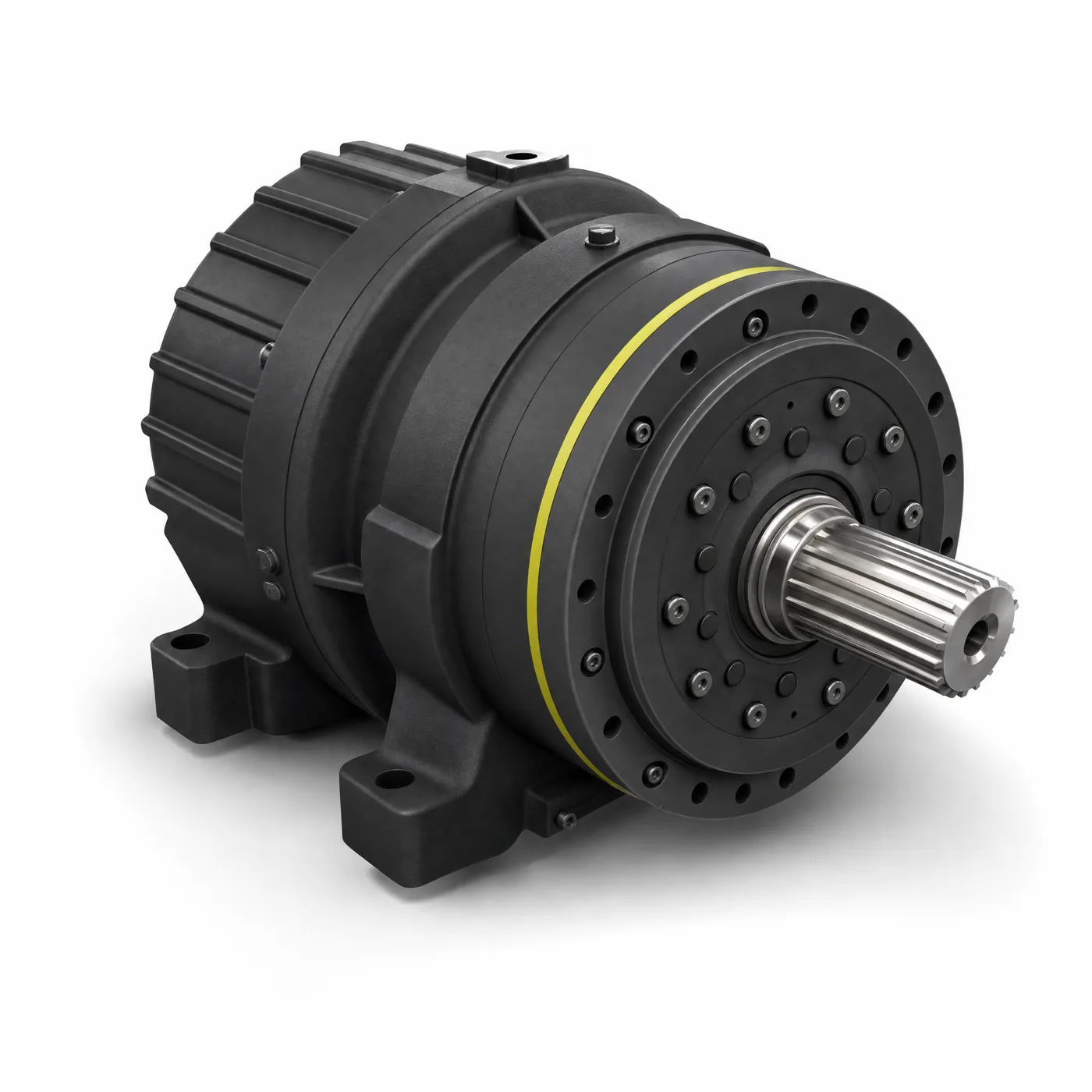
How the Planetary Gearboxes works.
Load shared across three planets
Three or more planet gears distribute the torque evenly around the ring gear circumference. This yields maximum power density in a compact, coaxial configuration.
Coaxial = minimal space
Input and output sit on one axis. No offset, no unnecessary transverse forces — saving space, weight and interfaces in the drivetrain.
Calculated on the load spectrum
Shock peaks, starting torques, reversing operation and ambient conditions all flow into the design — not an embellished nominal rating.
Where our drives work.
Wherever high torque meets tight installation space — from heavy industry to power generation.
- Drum and conveyor drives
- Mixers, agitators and extruders
- Hoisting and slewing gear on cranes
- Reel and winding drives
- Turbine and generator coupling
- Mill and crusher drives
The knowledge behind the design.
A planetary gearbox is the right choice when:
- high torque is required within a minimal installation space,
- input and output need to sit coaxially on one axis,
- low weight combined with high power density matters,
- a large ratio must be achieved in just a few stages.
Load sharing reduces flank pressure
Three or more planets share the torque — each tooth mesh carries only a fraction. This reduces flank pressure and component size at equal power and is the reason for the high power density.
Staging determines the ratio
Ratios of roughly 3 to 10 are common per planetary stage; with multiple stages we reach i up to ~1,500. More stages mean more ratio, but each stage costs some efficiency.
Designed for the load spectrum
Shock peaks, starting and reversing torques are factored into the design via the service factor. The result is a drive that reaches its planned service life even under real conditions.
Power density
Transmittable torque per installation space or weight. Planetary gearboxes achieve particularly high power density by distributing the load across multiple planets.
Torque (Nm / kNm)
The torque applied at the shaft — the central design parameter of a gearbox. What matters is not only the nominal torque, but the maximum peak torque under real operating conditions.
Ratio i
Ratio of input to output speed (i = n_in / n_out). A high ratio converts high speed into high torque — achievable across multiple stages.
Load spectrum
The time-based distribution of all occurring loads — continuous load, peaks, starting and shock torques. A serious design calculation works with the load spectrum, not with a single nominal rating.
Flank pressure (contact stress)
The contact stress on the meshing tooth flanks. It limits service life (pitting) and is verified during design against material strength and heat treatment.
Planetary Gearboxes by ATP — designed for your real load spectrum, not picked from a catalogue.
What sets us apart from off-the-shelf.
Designed for your load profile
We calculate every gearbox on the actual load spectrum and the real operating conditions of your plant — not merely on a theoretical nominal rating.
Brand-independent service
We maintain, repair and replace gearboxes from all manufacturers — including reverse engineering of legacy equipment and spare parts to original dimensions or with an improved design.
Fast support when it matters most
Downtime does not keep office hours. Our service hotline is staffed around the clock — we assess the situation, agree the next steps with you and dispatch our service technicians right away.
Engineering from Austria
Design, manufacturing and service from a single source in Marchtrenk — since 1995. Short paths, dedicated contacts, full responsibility for the result.
Frequently asked questions.
/ 01Up to what torque do you supply planetary gearboxes?+
Our series cover approx. 5 to 2,500 kNm. For higher requirements we design heavy-duty or custom-built units — the best approach is to discuss your specific load profile directly./ 02Planetary gearbox or helical gearbox — which is better?+
Planetary gearboxes deliver significantly more torque in the same installation space and offer a coaxial configuration. If power density and compact dimensions count, they are the first choice. If the shafts run parallel and easy maintenance or purchase cost come first, the helical gearbox wins./ 03Can you replace or rebuild an existing planetary gearbox?+
Yes. We reverse-engineer legacy gearboxes from all manufacturers and deliver a fitting — often improved — replacement including identical mounting dimensions./ 04How long do design and delivery take?+
After the initial consultation you quickly receive a first assessment. Depending on complexity, concept to delivery typically takes 12–28 weeks; retrofits are often considerably faster.
Your load profile. Our design.
Send us torque, speed, installation space and application — our engineers reply within 24 hours with a well-founded initial assessment.